


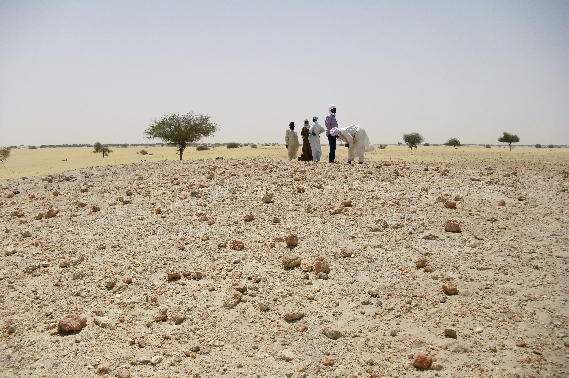
 Photo: Carlos Magnavita
Project management: Dr. Carlos Magnavita
Project Staff: Cezary Szymanski
Project Partners: Prof. Dr. Dangbet Zakinet (University of N’Djamena), Prof. Dr. Tchago Bouimon (University of N’Djamena, Chad)
Duration: January 2019 – December 2025
Funding: German Research Foundation (DFG)
within the Priority Programme “Entangled Africa"
In this project, we examined the medieval origins of the Central African empire/sultanate of Kanem-Borno (8th/9th–19th centuries CE). As one of the oldest historically known pre-colonial states south of the Sahara, the empire still raises many questions. At the start of the project, it was not known where its early centers of power were located or what they looked like, nor with which African regions outside North Africa the empire maintained relations prior to the 15th century. In contrast to the existing and largely researched historical documents, archaeology offers largely untapped sources of information about Kanem-Borno. This is particularly true for the empire’s early development prior to the 15th century. The project focused on the collection and analysis of material evidence that provides insights into previously little-known historical processes of this period. Particular attention was paid to the investigation of archaeological sites with brick structures in the Kanem region, east of Lake Chad in present-day Chad. Thanks to research conducted in recent years, a clearer picture of the early Kanem-Borno Empire is now emerging. Although archaeological evidence from its formative period (8th–10th centuries) is lacking, important findings are now available regarding its heyday from the 11th to the 14th century. Extensive field surveys in Kanem have not only uncovered the oldest and largest concentration of brick sites south of the Sahara. This discovery also demonstrates that the Lake Chad region boasts the longest architectural tradition of using bricks as a building material south of the Sahara (11th–18th centuries). In addition to the surveys, the project’s excavations yielded artifacts that also shed light on important historical processes and locations. For example, chemical analyses of glass beads suggest that between the 12th and 14th centuries, Kanem-Borno had direct or indirect connections to the West African rainforest in southern Nigeria and to the East or Northeast African coast. The excavation of an elite brick building with lime-plastered interior walls and a courtyard at the Tié site also suggests that this location is most likely Njimi, the empire’s first Islamic capital.
An important step toward the completion of the project was the submission of Cezary Szymanski’s dissertation in August 2025 to the Examination Office at Goethe University. The study, titled “A Study of Kanem-Borno’s Imperial Pottery (9th–19th century),” is the first academic work to address imperial pottery on an unprecedented scale and in unprecedented depth.
The work relies primarily on descriptive and more complex statistical methods to draw well-founded conclusions about the chronological and spatial relationships of individual ceramic inventories, regions, and communities within the empire.
Media response
Ein Palast unter dem Sand
Frankfurter Archäologen graben im Tschad nach der ersten islamischen Hauptstadt des Königreichs Kanem-Borno
Der Tagesspiegel, 21 October 2020
Journal de 20H Tele Tchad, 27 November 2023
Interview (French) on the opening of the special exhibition at the Chadian National Museum, 7 December 2024
Science Clip
Landscapes of Kanem, Chad
Enjoy the beautiful landscapes of Kanem (Chad), recorded by a drone in February 2019.
by Carlos Magnavita