How to Do Things with Plants: Easy and Uneasy Collaborations with Plants
Anne Meneley

Photos: Author with Singapore’s Lipstick Palm. February 2023, copyright Anne Meneley
Greening the City: Plants, Gardens and Imaginaries of Statehood in Singapore
Highlighting the Human Hand in Planting: Gardens by the Bay
The Politics and Aesthetics of Georgian Gardens
Plants in Times of War: Examples from the Middle East
In these four papers, I explore how to do things with plants. While human agency is key here, I also explore planty agency as plants often do not conform to human desires to impose their will on the plants and the places where they grow. The theme of movement -- of plants, seeds, peoples, and infrastructures -- runs throughout this set of papers.
The third paper highlights a common theme throughout the papers: who are gardens intended for and how are they constructed. As in Singapore, gardens in the contemporary Republic of Georgia cannot be extricated from local and national politics. Even those not officially of the current government in Georgia, shadowy oligarchs behind the scenes, shape the plant possibilities, in ways that are not considerate of plants or people. My final paper will explore how plants and their human carers deal with war and the materiality of its damaging consequences for people, but also on soil, trees and plants. Using examples from Palestine, South Lebanon and Syria, I explore the intertwining of plant and human agency amid tear gas and landmines, demonstrating resistance and tenacity in difficult times.
08. Juni (Raum 1.801 Casinogebäude): Greening the City: Plants, Gardens and Imaginaries of Statehood in Singapore
15. Juni (Raum 1.801 Casinogebäude): Highlighting the Human Hand in Planting: Gardens by the Bay
22. Juni (Raum 1.812 Casinogebäude): The Politics and Aesthetics of Georgian Gardens
29. Juni (Raum 1.801 Casinogebäude): Plants in Times of War: Examples from the Middle East
Jeweils montags - 16.15 bis 17.45 Uhr
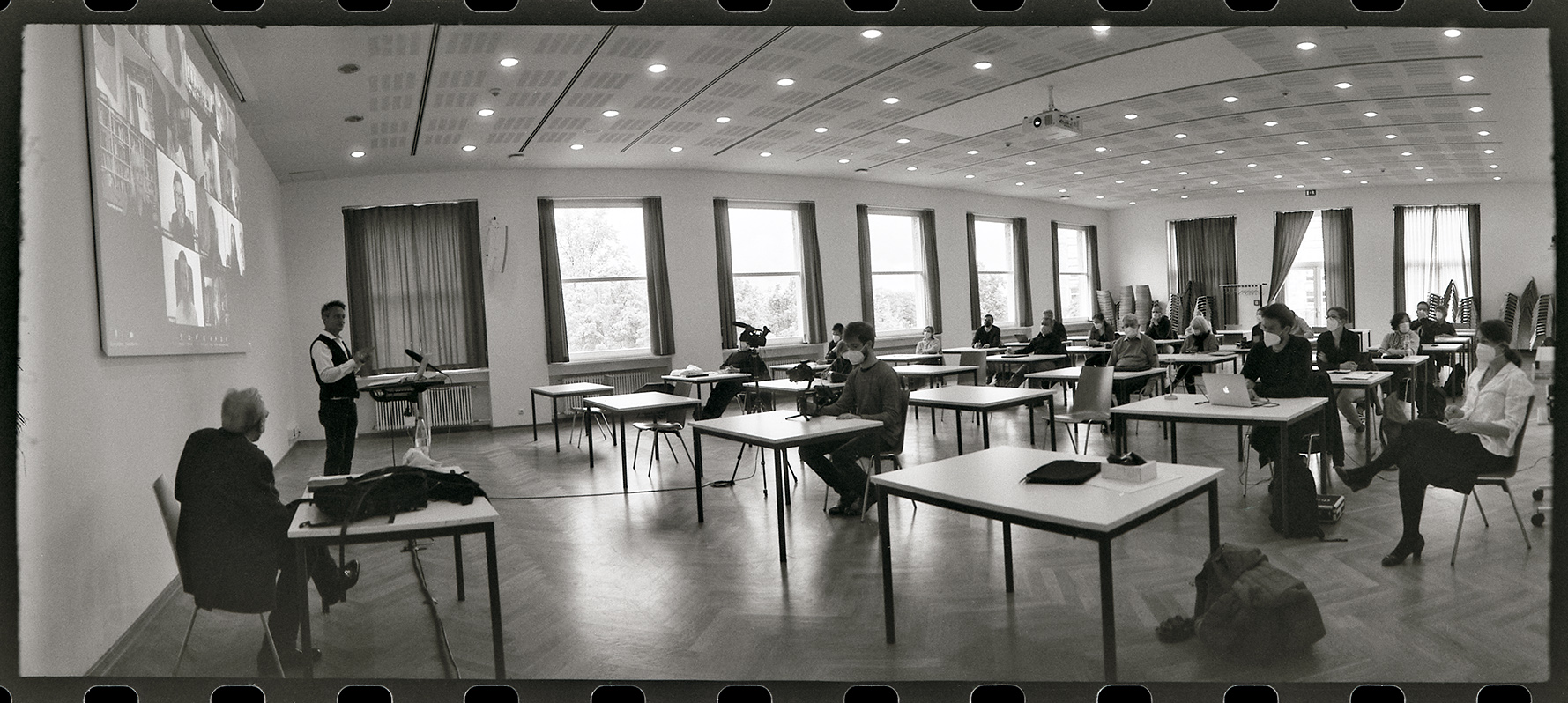
Foto: Peter Steigerwald
Über die Ad.E.Jensen-Gedächtnisvorlesung
Das Frobenius-Institut lädt im jährlichen Turnus renommierte Wissenschaftler aus dem Ausland zu einsemestrigen Gastvorlesungen ein. Die Vorlesungsreihe ist dem Andenken an Adolf Ellegard Jensen (1899–1965) gewidmet, der 1946 zum Leiter des Frobenius-Instituts, zum Direktor des Völkerkundemuseums und zum ersten Inhaber des Lehrstuhls für Kultur- und Völkerkunde an der Johann Wolfgang Goethe-Universität ernannt wurde. Die Themen der Vorlesungen sollen sich im Umkreis der von Jensen inaugurierten Forschungen zu Mythus und Kult bewegen, doch ist den Gastwissenschaftlern das jeweilige Thema freigestellt. Die Vorlesungsreihe wird aus Mitteln der Hahn-Hissink'schen Frobenius-Stiftung und der Frobenius-Gesellschaft e.V. finanziert.
Live-Mitschnitte der vergangenen Vorlesungen finden Sie auf dem YouTube-Kanal des Frobenius-Instituts 
Folgende Ad. E. Jensen-Gedächtnisvorlesungen haben bisher stattgefunden:
2024: "Historical ethnography and the ritual archive", Prof. Dr. Andrew Apter
2023: "Incompleteness, mobility and conviviality", Prof. Dr. Francis B. Nyamnjoh (Cape Town)
2022: "Connectivity: Insights from Hunter-Gatherer Cultures", Prof. Dr. Nurit Bird-David (Haifa)
2020: (Die Ad.E. Jensen-Gedächtnivorlesung 2020 musste angesichts von COVID-19 leider entfallen).
2019: "A genealogy of method: anthropology's ancestors and the meaning of culture", Prof. Sondra Hausner (Oxford)
2018: "Values, Social Theory, and the Anthropological Study of the Good", Prof. Joel Robbins (Cambridge)
2017: "On the pursuit of wealth and happiness: Some lessons from Central India", Prof. Chris Gregory (Canberra)
2016: "Repatriating Anthropology - Ethics and empirics in some lessons from Native America", Prof. Justin B. Richland (Chicago)
2015: "Cultures and Translation", Prof. Souleymane Bachir Diagne (New York)
2014: "Fieldwork in Philosophy: Refiguring Social Inquiry's Conceptual Ground", Prof. Ann Laura Stoler (New York)
2013: "From Artifact to Primitive Art", Prof. Nancy Lutkehaus (Los Angeles)
2012: "Is Religion a Special Form of the Social?", Prof. Maurice Bloch (London)
2011: "The Anthropology of Encounter - From 'First Contact' to the Everyday", Prof. Francesca Merlan (Canberra)
2010: "Kult und Kunst - Ästhetik des ethnographischen Archivs", Prof. Dr. Fritz W. Kramer (Berlin)
Publikation: "Kunst im Ritual. Ethnographische Erkundungen zur Ästhetik", Reimer-Verlag, Berlin 2014
2008: Ringvorlesung "The end of anthropology?": Adam Kuper (London), Ulf Hannerz (Stockholm), Signe Howell (Oslo), Maurice Godelier (Paris), Antonio Palmisano (Triest), John Comaroff (Chicago), Vincent Crapanzano (New York), Patricia Spyer (Leiden) und Mark Münzel (Marburg)
Publikation: "The End of Anthropology?", edited by Holger Jebens and Karl-Heinz Kohl, Sean Kingston Publishing, 2011
2006: "The Making of Colonialism in Equatorial Africa", Prof. Dr. Robert Harms (Yale)
2005: "Amazons: Women Warriors of Dahomey in and out Africa", Prof. Dr. Suzanne Preston Blier (Harvard)
2004: "Colour of the Sacred", Prof. Dr. Michael Taussig (New York)
Publikation: "What Colour is the Sacred?", University of Chicago Press, 2009
2001: "Violence, Social Order and the Spectral State. Policing The South African Postcolony", Prof. Dr. Jean Comaroff, Prof. Dr. John Comaroff (Chicago)
2000: "Emotion: Experience and Expression - A Cross-Cultural View", Prof. Dr. Unni Wikan (Oslo)
1999: "The Anthropology of Imagination" Prof. Dr. Vincent Crapanzano (New York)
Publikation: "Imaginative Horizons. An Essay in Literary-Philosophical Anthropology", University of Chicago Press, 2003
1998: "The Crisis of Presence: Death and Alterity in Amerindian Amazon" Prof. Dr. Tullio Maranhão (St. Paul)
1997/98: "Out of our Minds. Science, Ecstasis and the Ethnography of Africa" Prof. Dr. Johannes Fabian (Amsterdam)
Publikation: "Out of Our Minds. Reason and Madness in the Exploration of Central Africa", University of California Press, 2000